How Libraries Decide Where a Book Goes: Call Numbers for Beginners
Libraries give every book one fixed shelf address called a call number, built from a classification system such as Dewey Decimal or Library of Congress. Learning to read that code turns a wall of spines into a collection you can navigate.
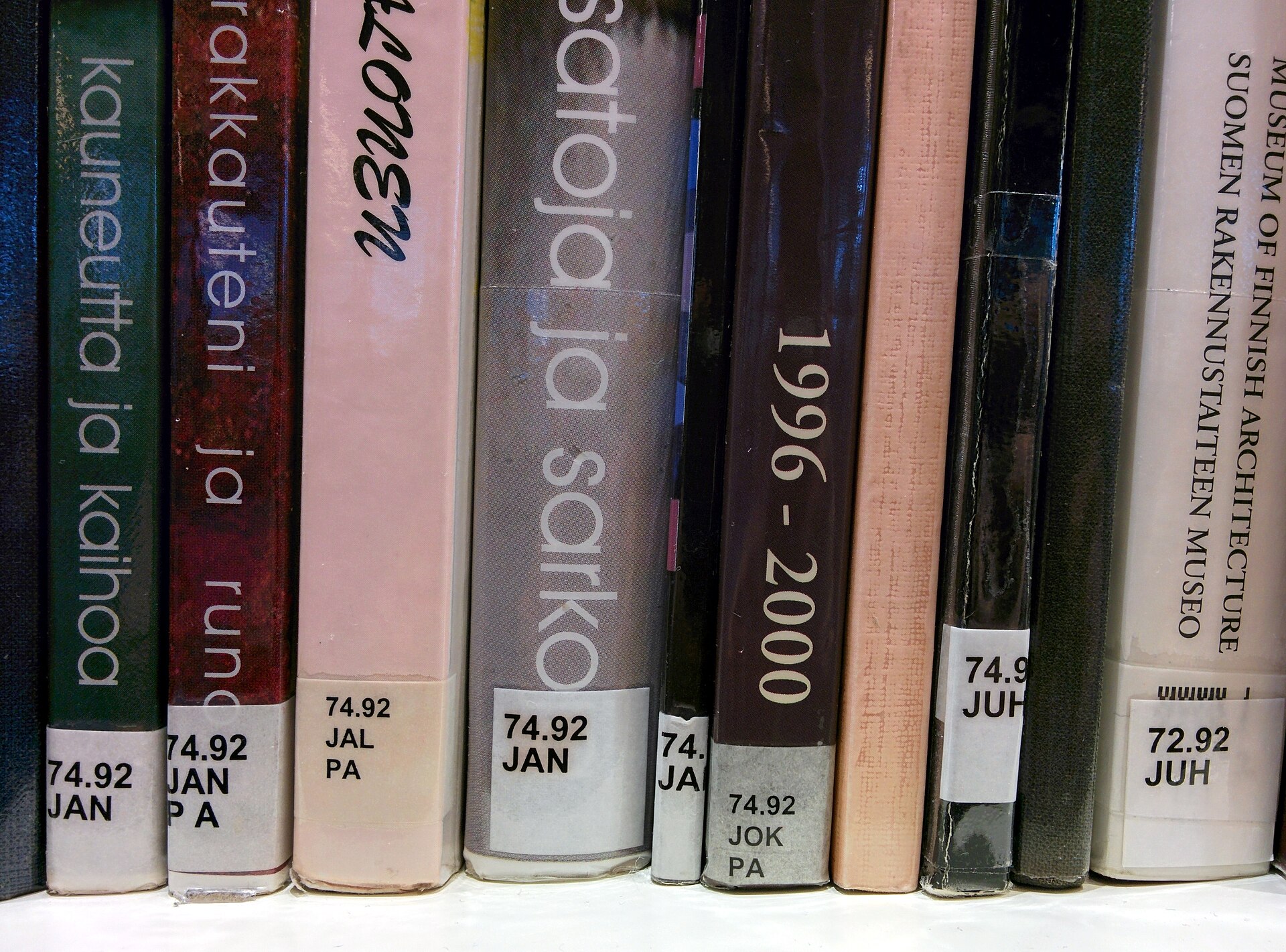
Cover: Own work · Wikimedia Commons · CC BY-SA 4.0
Question: How do libraries decide where a book belongs on the shelf?
One book, one fixed address
A library with tens of thousands of volumes cannot rely on memory or a rough theme. Instead, each item is assigned a single position in a defined sequence, so a book has exactly one correct shelf spot. That predictability is the whole point: a book put back correctly can be found again by anyone, years later, without asking a person who was there when it arrived. The system also groups related subjects together, which is why browsing near one useful book often turns up another.
What a call number actually is
The call number is the code printed on a small label on the spine and repeated in the library's catalog record. It usually has two parts: a classification portion that stands for the subject, and a second portion, often based on the author's name or the title, that keeps books on the same subject in a stable order. Because of that second part, two books about the same topic do not compete for the same spot; each gets its own distinct address.
Dewey Decimal: ten broad neighborhoods
The Dewey Decimal Classification, first published in the 1870s and maintained today by OCLC, divides all knowledge into ten main classes numbered 000 through 900. In general terms, 000 covers general works and computing, 100 philosophy and psychology, 200 religion, 300 social sciences, 400 language, 500 science, 600 technology, 700 arts and recreation, 800 literature, and 900 history and geography. Longer numbers with decimal places narrow the topic, so 500s lead to 590s for animals and then to a specific group of animals. Most public libraries and school libraries use Dewey for at least part of their collection.
Library of Congress: letters plus numbers
Many college, university, and research libraries use the Library of Congress Classification instead. It starts with letters rather than digits, with each letter standing for a broad area such as A for general works, B for philosophy and religion, or Q for science, and it combines those letters with numbers and letter-number combinations to reach increasingly specific subjects. Because it can expand more freely, large collections that grow steadily tend to favor it.
Reading a label on the shelf
Call numbers are read in groups, in order, from the top line of the label downward. Compare the classification portion first, then move to the following portions, character group by character group, until you find a difference. Numbers in a classification portion are compared by value, not as plain text, so a longer number can sit between two shorter ones. Practically, this means you walk to the right area, then scan labels rather than titles until you reach the exact match.
Not everything uses the same scheme
Fiction is commonly shelved separately by the author's surname, and many public libraries do the same for mysteries, science fiction, or graphic novels. Films, audiobooks, music, and magazines often have their own areas or a short prefix in front of the call number. Children's and young adult materials may form distinct sections with their own labeling. The catalog record tells you which collection an item belongs to, so the location line matters as much as the number itself.
A simple way to start
Search the catalog for the title or subject you want, then write down the full call number and the collection or floor it names. Go to that area, find the first portion of the number on the shelf ends, and narrow down portion by portion. If the exact book is out, the books immediately around it are usually on the same subject, which is a reasonable place to browse. Before leaving, note how the shelf is arranged so you can put anything you pull out back in the right place.