Choosing a mystery book can mean deciding whether you want to settle into a story or actively work the case. The Killer Isn't Alice: the 46,600 Suspect Murder Mystery Puzzle is aimed at the second kind of reader: its plot asks you to follow hidden clues, make notes, and navigate branching paths toward different endings.
Quick verdict
At USD 34.99, The Killer Isn't Alice is a focused pick for puzzle-minded readers who enjoy turning a murder mystery into a written reasoning activity. The central appeal is not simply the premise; it is the casebook-style format, with story text, clues to uncover, and space intended for recording deductions as the investigation develops.
Choose it if working through theories, tracking details, and revisiting a mystery sound more appealing than reading a conventional start-to-finish whodunit. The meaningful trade-off is that the branching structure puts decision-making at the center of the experience, so readers looking for one fixed narrative route may find the format less direct.
Who it suits
This mystery-puzzle book makes the most sense for:
- Readers who like to pause and assemble clues before moving on.
- Puzzle fans who enjoy logic-based activities with a story attached.
- Students or groups looking for a compact mystery activity to discuss together.
- Travelers and casual readers who want a 21 x 14 cm casebook format that can fit into a bag or sit easily on a desk.
It is also a natural gift idea for someone whose reading tastes overlap with escape-room-style puzzles, detective games, or journal-based activities.
What stands out in the format
The distinctive feature is the combination of narrative and participation. Each page is designed to move the story forward while placing clues within the text, encouraging readers to keep their own trail of observations. Rather than treating notes as an optional extra, the format builds written deduction into the experience.
The special matte paper is another practical touch for that use. It is intended to support writing and repeated erasing, which suits readers who like to revise a suspect list, redraw connections, or change their interpretation as new details emerge.
Multiple ending paths add another layer of involvement. A branching mystery can make the outcome feel tied to the reader's reasoning and choices, and it gives the concept a replayable angle that a single linear plot does not emphasize.
Meaningful trade-offs
The same features that make The Killer Isn't Alice engaging can make it a less natural choice for readers who prefer to absorb a mystery without stopping to write. Hidden clues and note taking ask for attention beyond ordinary page-turning.
Likewise, branching endings favor readers who enjoy exploring possibilities. If the main goal is a neatly fixed detective story with one prescribed route, the logic-game structure may feel like an added layer rather than the main attraction.
The Killer Isn't Alice: the 46,600 Suspect Murder Mystery Puzzle
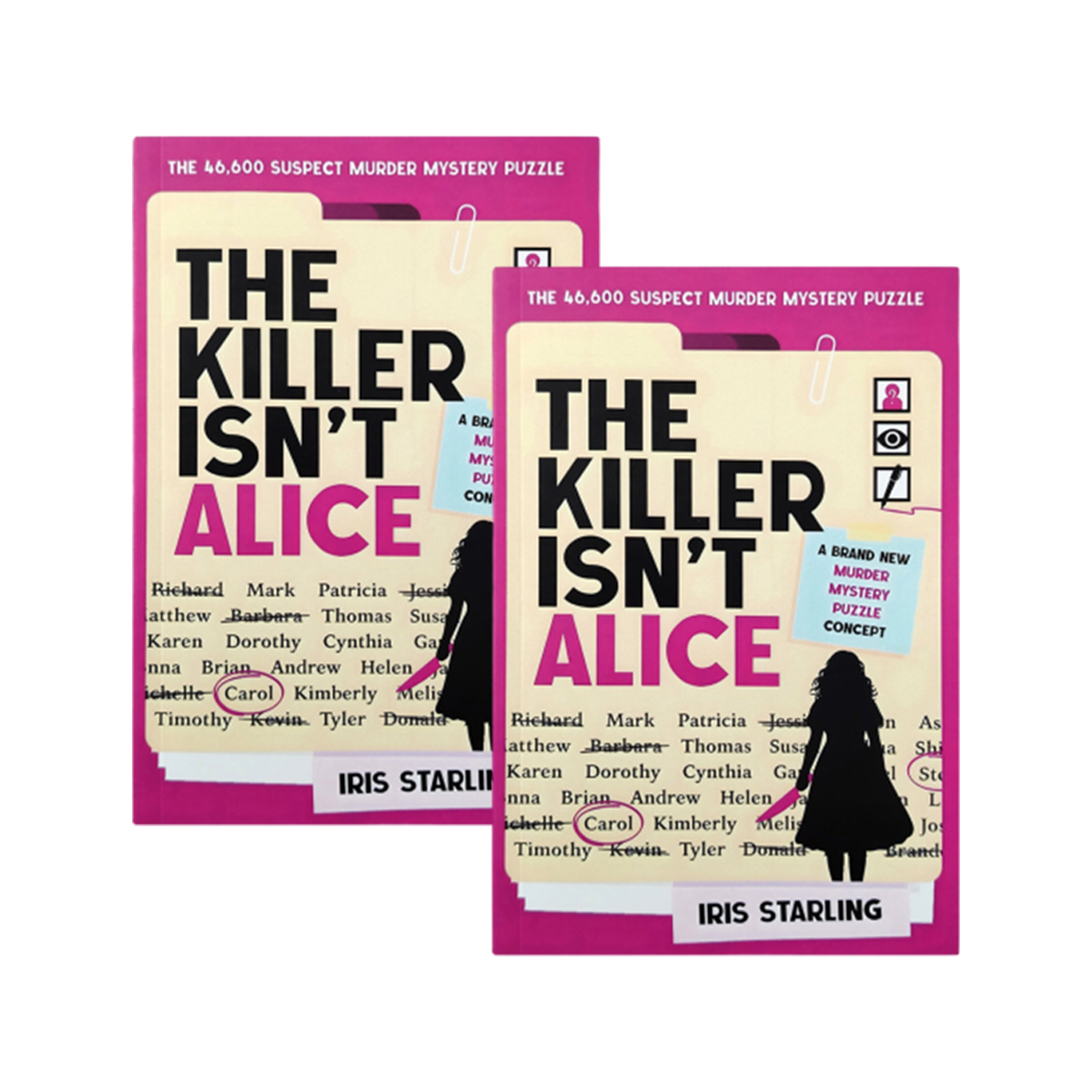
Pick this title for an interactive casebook experience: the hidden-clue plot, writable matte pages, and branching narrative give puzzle solving a clear role in the reading. Its limitation is equally clear-this is built around active reasoning and written notes, not an uninterrupted linear mystery read.
Bottom line
The Killer Isn't Alice is best for readers who want their mystery to double as a puzzle activity. Its portable casebook size, note-friendly pages, and choice-driven story design make it especially appealing when solving the case is as important as discovering the ending.